Derui chamber
OFFICE CHAIR TESTING · LABORATORY WORKFLOW
A chair test is only useful if another operator can understand how it was prepared, loaded and assessed. For furniture manufacturers and testing laboratories, a practical ANSI/BIFMA X5.1 protocol connects the selected method to the specimen, fixture, machine settings and final record—not just a cycle counter.
1. Confirm the standard and the chair configuration
BIFMA lists ANSI/BIFMA X5.1-2017(R2022), General-Purpose Office Chairs–Tests. The R2022 designation indicates reaffirmation. Record the exact edition requested by the customer or programme rather than shortening it to “X5.1-2022.” BIFMA’s official standard description is linked in the references below.
Confirm whether the chair and its intended use belong within this scope. Large-occupant office chairs and public/lounge seating have separate BIFMA standards; they should not automatically inherit an X5.1 test plan. For the scope and equipment-selection background, see our BIFMA X5.1 office chair testing guide.
- Identify the model, production revision, intended use and adjustment features.
- Document relevant components: arms, backrest, base, casters, swivel, tilt mechanism and footrest, where present.
- Resolve applicable tests and exclusions with the responsible laboratory reviewer before programming equipment.
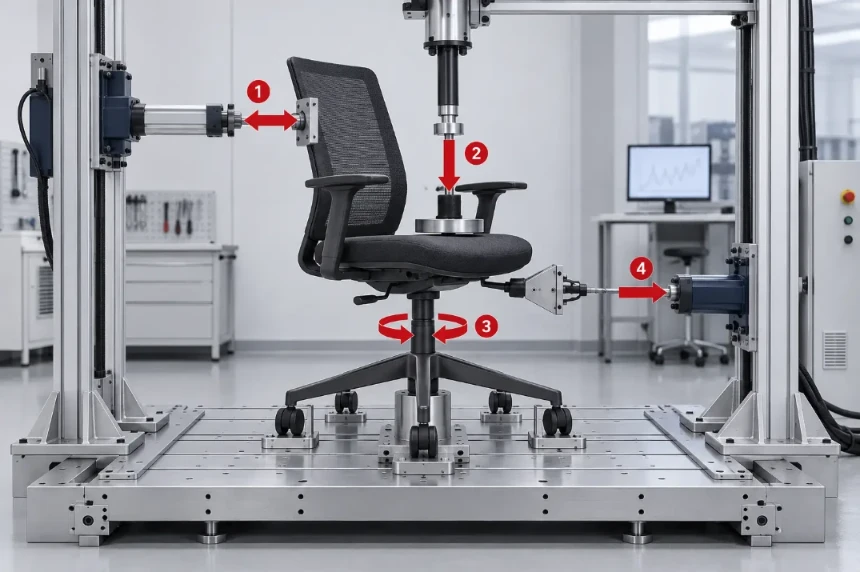
2. Build a method-to-record matrix before testing
Keep three documents distinct: the test plan decides what will be evaluated; the SOP describes how the laboratory executes a selected method; the test record captures what actually happened. The matrix below is a recommended planning template, not a reproduction of BIFMA requirements.
| Planning field | What to establish |
|---|---|
| Method reference | Standard edition, applicable test name and exact clause reference from the controlled copy. |
| Specimen assignment | Specimen ID, chair configuration, sample count and any permitted sequence or specimen reuse. Do not assume one chair can undergo every test. |
| Fixture and contact geometry | Load location, loading pad or attachment, restraints, adjustment positions and clearances specified by the method. |
| Operating settings | Required load or mass, duration, travel, speed and cycle definition, as applicable. Record units and the approved programme revision. |
| Assessment | Method-specific acceptance criteria, required observations and the person authorised to review results. |
| Evidence | Setup photographs, readings or logs, equipment IDs, observations and interruption/deviation records. |
Avoid a single “standard load table” copied into every programme. A proof-load test, impact test and fatigue test do not use interchangeable quantities. Likewise, completing a programmed run does not, by itself, establish a passing result.
3. Pre-flight checks: four things to verify
Specimen and fixtures
Check the specimen ID and agreed assembly condition. Photograph adjustment positions and load contact points. Confirm that a fixture does not restrain a movement the selected method is intended to evaluate.
Measurement chain
Identify the instruments used to establish force, mass, distance or time. Confirm suitable range, current calibration status and relevant setup checks; a controller display alone is not evidence of measurement suitability.
Programme and counter
Compare the settings with the approved method. Clarify whether a count represents a stroke, reversal, revolution or complete loading cycle. Record any software or recipe revision relevant to the run.
Safety and records
Check guarding, emergency stop, specimen clearance and the laboratory’s safe setup procedure. Prepare observation and interruption fields before testing begins, rather than reconstructing events afterwards.
For practical measurement checks and documentation, use the furniture testing equipment calibration checklist. Machine commissioning, routine verification and instrument calibration are related activities, but they are not interchangeable.
4. Execute, monitor and control interruptions
- Prepare and condition the specimen as required by the selected method. Record the actual conditions and any specified conditioning period; do not treat a general laboratory temperature as a universal test requirement.
- Install the approved setup and verify contact position, clearance and any specified restraints before applying the test load.
- Run the authorised programme. Record the start condition and observe the specimen as required by the method and laboratory procedure.
- If a fixture slips, the load becomes unstable or a safety issue develops, follow the laboratory’s stop procedure. Save the count, readings, time and observations available at the interruption.
- Have the responsible reviewer determine whether a restart, continuation or new specimen is appropriate. Do not silently change the load or reset the counter to conceal an interruption.
- Inspect and assess the specimen using the selected method’s criteria. Record visible damage and functional changes separately from any proposed root cause.
For example, if a backrest attachment moves during a fatigue run, document the observed movement, specimen state and setup before attributing it to the chair or fixture. A photograph and interruption record support investigation; they do not alone prove a material, fastener or design defect.
5. Keep a test record that can be reviewed
| Record group | Suggested entries |
|---|---|
| Identity and authority | Job number, customer, specimen ID, model/revision, method/edition and approved plan reference. |
| Setup and measurements | Equipment and instrument IDs, fixture configuration, chair adjustment positions, setup photos and relevant verification results. |
| Execution | Approved settings with units, start/end times, actual readings or available logs, cycle counts and operator observations. |
| Interruptions and deviations | Time/count, reason, saved state, action taken and reviewer decision. Distinguish a planned pause from an unexpected event. |
| Assessment and review | Method-specific findings, acceptance decision, limitations, evidence references and review authorisation. |
An automatic PDF or CSV can help preserve readings, but it cannot replace missing setup information or an acceptance review. Specify the required export fields before buying equipment. Retain raw records alongside the final report according to your laboratory’s procedures.
6. Separate equipment capability from compliance claims
An equipment supplier can describe a machine’s functions and configuration. A laboratory establishes whether its setup and procedure are suitable for the selected method. Product conformance is a separate conclusion based on the applicable tests and their results.
For participation in BIFMA Compliant, BIFMA requires applicable testing in an ISO/IEC 17025-accredited laboratory with the relevant BIFMA standards in its accreditation scope. Buying a tester or collecting automatic reports does not grant laboratory accreditation or register a chair in that programme. Check the official programme rules before making marketing claims.
7. Translate your test plan into an equipment enquiry
Use the method matrix to prepare the enquiry, then review the chair testing equipment range against the actual work your laboratory needs. A seat/back durability tester, impact tester and stability tester serve different purposes; none should be described as covering the complete X5.1 programme without a configuration review.
- Send the standard edition, selected tests and customer/programme requirements.
- Provide chair dimensions, adjustment range, specimen mass and photographs of the relevant contact areas.
- Identify required load/mass ranges, fixture geometry, measurement checks and reporting fields from the methods.
- Describe expected throughput, sample handling, utilities, available space and installation constraints.
- Ask which functions and accessories are included, which are optional, and which tests need separate equipment.
Frequently asked questions
Can I use the same settings for every office chair?
No. Determine applicable tests from the selected standard and chair configuration. Use controlled method requirements, not values copied from a supplier article or another chair’s report.
Should stability always be tested first?
Do not prescribe a universal order. Establish specimen allocation, sequence and permitted reuse from the selected methods and the approved laboratory plan.
Does reaching the target cycle count mean the chair passed?
No. The count describes execution progress. Passing requires assessment against the applicable criteria, including relevant observations and functions, with any interruptions or deviations considered.
Is this handbook a complete BIFMA test SOP?
No. It is a workflow and record-planning guide. A usable SOP also needs the exact requirements from the controlled standard, a verified machine/fixture setup and approval within the laboratory’s procedures.
Related equipment
- DR-J609 Chair Seat & Back Durability Tester
- DR-J607 Chair Drop Impact Tester
- DR-J608 Chair Stability Tester
Official references
- BIFMA: standard descriptions and designations
- BIFMA / Accuris: ANSI/BIFMA X5.1-2017 (R2022)
- BIFMA Compliant: programme and laboratory requirements
This article provides planning guidance. For normative loads, durations, counts, specimen allocation and acceptance criteria, use the licensed standard and your laboratory’s approved procedures.