Derui chamber
SEATING STRENGTH & DURABILITY · LABORATORY PLANNING
Choosing an ISO 7173 seating tester starts with the tests you need—not the number of actuators on the machine. Chair and stool manufacturers need fixtures, loading control and records that match an agreed test plan. A large frame or a high cycle counter alone does not establish method compatibility.
1. Scope and edition: start with the right document
This guide uses ISO 7173:2023, the published edition for structural strength and durability testing of chairs and stools. Its scope is broader than upright office seating. Children’s highchairs, table-mounted chairs and bath seats are excluded; upholstery durability, ageing, degradation, ergonomics and electrical functions are outside its test scope.
ISO also lists an ISO/DIS 7173 revision under development, with stability included in its title. Do not treat that draft as the published 2023 edition. Check the official catalogue and the customer’s requested edition when agreeing a test plan.
A structural seating test does not answer every product-safety question. Start from the product and intended market, as explained in What Testing Is Required for Furniture?, and identify any additional requirements separately.
2. ISO 7173 versus ISO 7174: strength is not stability
| Document | Planning distinction |
|---|---|
| ISO 7173:2023 | Structural strength and durability methods. Use the selected methods and agreed assessment basis for the seating product. |
| ISO 7174-1:1988 | Stability methods for upright chairs and stools, with important scope exclusions. Do not automatically apply it to swivelling chairs, rocking chairs or multiple seating. |
| ISO 7174-2:1992 | Stability of specified tilting/reclining chairs in the fully reclined position and rocking chairs; confirm the relevant configuration and methods. |
| ISO/DIS 7173 | A revision in development, not the same document as ISO 7173:2023. Review its status before changing a contract or laboratory procedure. |
A chair can retain its structural integrity yet overturn in a separate stability evaluation. Conversely, resistance to tipping does not establish fatigue performance. Keep the method references and conclusions distinct rather than labelling all seating tests “ISO 7173 compliance.”
3. Agree severity and acceptance before programming
Ask the laboratory or customer to identify the required tests, settings and acceptance basis. Do not assume a severity label has the same meaning across editions, contracts or seating applications. Likewise, a method reference without the intended loads and cycle requirements is not a complete equipment specification.
| Required input | Why the equipment supplier needs it |
|---|---|
| Method and edition | Determines which procedure and setup are being assessed. Include exact references from the controlled standard. |
| Product configuration | Chair or stool dimensions, material construction, adjustment positions, arms, backrest and other relevant features. |
| Test settings | Loads or masses, timing, counts, travel and other settings specified for the selected work, with units. |
| Geometry and accessories | Loading points, pads, impact apparatus where applicable, supports and permitted restraints. |
| Specimen plan | Sample allocation, sequence and permitted reuse established by the responsible laboratory. |
| Assessment and records | Acceptance basis, observations, raw data and reporting needed to review the result. |
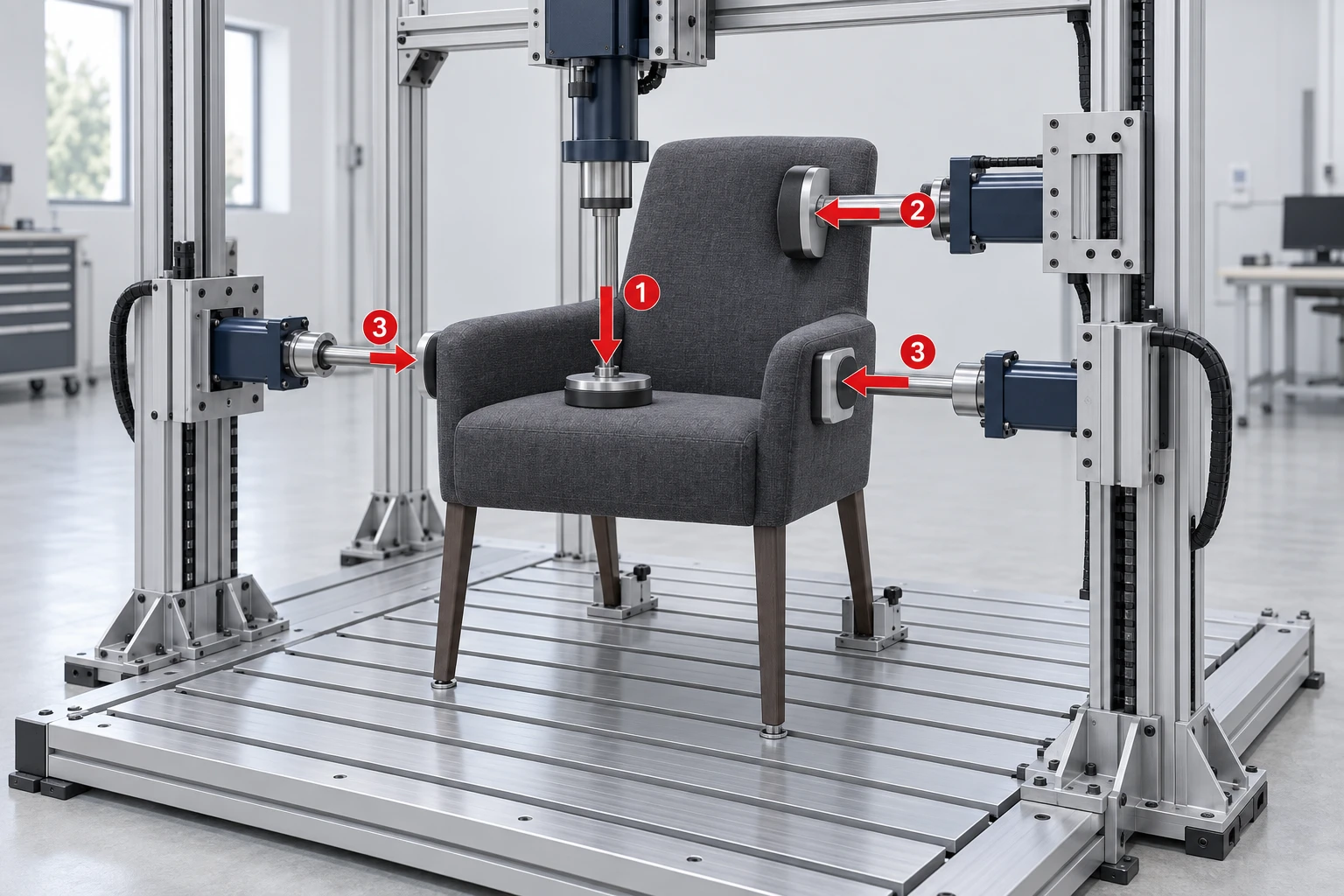
For example, “test a padded visitor chair” is not enough to quote a suitable rig. A useful enquiry identifies the selected seat/back procedures, chair dimensions, required settings and contact geometry. Arm or impact work should be listed separately, not assumed to be included.
4. Four setup checks that affect the test
Loading points and pads
Establish positions using the selected procedure and appropriate locating apparatus. Verify pad shape, size and contact behaviour; do not replace the required pad with a convenient flat plate without review.
Floor, stops and movement
Confirm the specified test surface and restraints. A stop intended to control sliding must not inadvertently brace a joint or prevent the deformation being evaluated. Keep setup photographs.
Force control and travel
Check the loading system’s usable range, feedback and travel for the specimen. Cushion compression and frame movement can change contact conditions; confirm that the approved setup maintains the intended loading behaviour.
Timing and combined actions
Review hold periods, release behaviour and any required relationship between loading actions. A machine’s maximum cycle rate is not a universal test rate, and two actuators do not automatically provide the correct sequence.
Cylinder pressure is a machine-control input; it is not, by itself, a measurement of force applied to the specimen. Review the actual measurement arrangement, contact geometry and verification procedure rather than relying on an assumed pressure-to-load conversion.
Use the furniture testing equipment calibration checklist to plan instrument identification, calibration status and relevant verification records. Do not confuse controller resolution, sensor calibration and complete-system performance.
5. Execute and record without hiding deviations
- Identify and prepare the specimen using the selected method and approved laboratory plan. Record the relevant assembly and adjustment condition.
- Verify fixtures, contact locations, measurement checks and programme settings before starting. Keep the approved recipe or settings record.
- Observe and record execution as required. Separate the programmed count from evidence of the load actually applied.
- If contact is lost, a restraint moves or an unexpected interruption occurs, use the laboratory’s stop procedure and preserve the available count, readings and photographs.
- Have the responsible reviewer decide whether continuation, repetition or a new specimen is appropriate. Record the decision and any limitation.
- Assess the specimen against the agreed criteria. A completed run is not an automatic pass, and visible damage alone does not establish its engineering root cause.
Useful report inputs include specimen and equipment IDs, standard edition and method references, fixture photographs, actual settings, relevant readings, observations, interruptions and the assessment decision. Keep execution evidence distinct from later design recommendations.
6. Select equipment by demonstrated function
Review the chair testing equipment range against your method list. Confirm load capacity, travel, loading geometry and accessories for each proposed configuration. A model name or a generic “ISO compatible” statement is not a substitute for that review.
- Seat/back loading: confirm the required static or cyclic functions, usable force range, fixture travel and loading sequence.
- Arm, leg or other structural work: identify the selected procedures and check whether additional actuators, pads or fixtures are needed.
- Impact evaluation: verify the method-specific impact apparatus; do not assume a drop tester designed for another seating standard is interchangeable.
- Stability: review the separate applicable method and chair configuration before selecting the loading arrangement.
- Reporting: agree which measurements and events can be exported, and which observations must be entered by the operator.
Ask for a configuration-specific proposal identifying included functions, optional accessories and tests requiring separate apparatus. Equipment capability does not certify a seating product or grant accreditation to a laboratory.
Frequently asked questions
Is ISO 7173 only for office chairs?
No. Its structural seating scope is broader. Confirm applicability and the selected procedures for the actual product rather than assuming the office-chair test plan fits every seat.
Can I copy the same load and cycle settings to every programme?
No. Use the selected edition, agreed severity and relevant method requirements. Confirm the loading geometry and timing as well as the numerical setpoints.
Does one multi-axis machine cover every seating test?
Not necessarily. Coverage depends on the selected methods, specimen envelope, actuators, fixtures, impact apparatus and other accessories. Ask the supplier to identify the configuration and its limits.
Does the newer draft replace my existing contract?
Do not change the agreed document silently. Check its publication status and resolve any edition change with the customer and responsible laboratory before altering the test plan.
Related equipment and planning guides
- DR-J609 Chair Seat & Back Durability Tester
- BIFMA X5.1 Office Chair Testing: Scope, Tests & Equipment
- How to Set Up a Furniture Testing Laboratory
Official references
- ISO 7173:2023: scope, edition and revision status
- ISO 7174-1:1988: upright chair and stool stability scope
- ISO 7174-2:1992: fully reclined and rocking chair stability
This is equipment and laboratory-planning guidance. Obtain the licensed standard for exact apparatus dimensions, settings and procedure requirements; have the laboratory approve the method-specific SOP.