Derui chamber
Build the Test Scope Before You Buy the Machines
A useful furniture testing laboratory is not defined by how many machines it owns. It is defined by whether its test scope, methods, fixtures, utilities, measurement controls and records work together. This guide gives manufacturers and laboratory teams a practical path from the first product list to a procurement-ready equipment configuration.
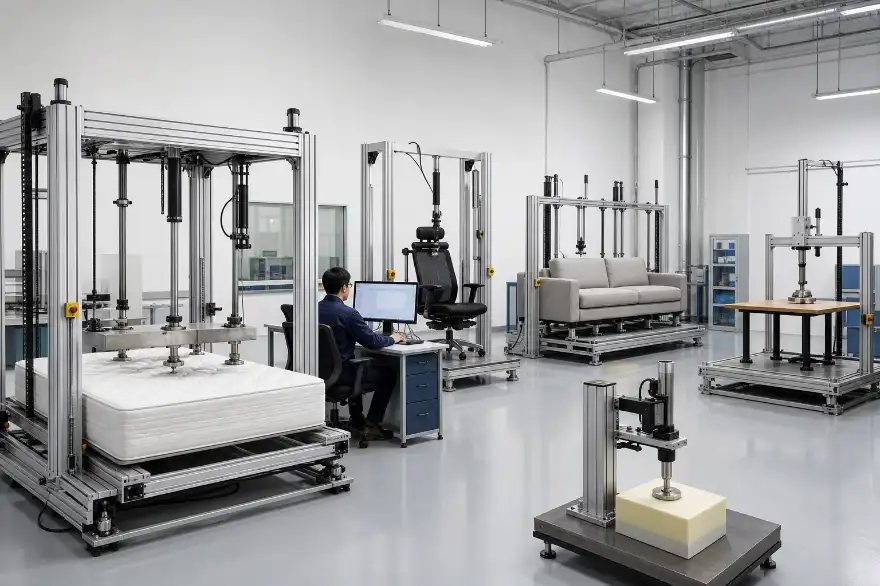
1. Decide What the Laboratory Must Accomplish
Start with business decisions, not a catalogue. An in-house quality-control lab may screen incoming materials, compare prototypes and monitor production consistency. A development laboratory may investigate failure modes and improve structures. A laboratory preparing reports for customers or an accreditation body needs stronger method control, measurement traceability, staff competence and record governance.
Product Scope
List the exact furniture families, size ranges, constructions and components that will be tested during the next three to five years.
Decision Scope
Define whether results support design comparison, incoming inspection, production release, supplier evaluation or formal conformity work.
Capacity Scope
Estimate samples per week, test duration, peak demand and whether long cyclic tests can run unattended under safe conditions.
Write one sentence for each intended use: “The laboratory shall evaluate office-chair strength and durability for the North American market,” or “The laboratory shall compare mattress durability and height loss during product development.” These statements become the foundation of the equipment specification.
2. Map Products, Markets and Test Standards
A product name is not enough to choose a test method. A domestic sofa, contract-lounge seat and office chair may use different standards even though all are seating. Confirm the destination market, intended use, purchaser specification and current standard edition before preparing the equipment list.
| Product family | Typical evaluation needs | Standards to investigate | Equipment starting point |
|---|---|---|---|
| Office and general seating | Static strength, cyclic durability, impact, swivel, base/caster performance and stability | ANSI/BIFMA X5.1, EN 1728, EN 1022, ISO 7173 and buyer-specific methods | Chair testing equipment, including the DR-J609 seat and back durability tester and DR-J607 chair drop impact tester |
| Sofas and upholstered seating | Seat/back fatigue, static load, arm/side load, frame and mechanism evaluation | EN 12520, EN 1728, ANSI/BIFMA X5.4 and applicable contract-seating requirements | Sofa testing equipment and the DR-J501 sofa fatigue tester |
| Mattresses and foundations | Durability, firmness change, height loss, impact and structural condition | ASTM F1566, EN 1957 and the purchaser’s mattress specification | Mattress testing equipment and the DR-J504 Cornell durability tester |
| Tables and desks | Stability, static load, strength, durability and impact as applicable | EN 1730, EN 527 series and product-/market-specific requirements | Table testing equipment and the DR-J701 table static load tester |
| Flexible foam and cushions | Indentation hardness, compression behavior, fatigue, thickness and recovery | ASTM D3574, ISO 2439 and applicable material specifications | Foam testing equipment, including the DR-J801 foam IFD hardness tester and DR-J802 dynamic fatigue tester |
This table is a planning aid, not a declaration of compliance. Always obtain the current authorized standard and confirm its scope, specimen preparation, apparatus, tolerances, procedure and reporting requirements. Derui can review equipment configuration, but the laboratory remains responsible for selecting the applicable method.
3. Turn the Standards into a Test-Method Matrix
Create one row for every test the laboratory intends to perform. This prevents a common purchasing error: buying a universal frame that can apply force, then discovering that it lacks the correct loading pad, restraint, geometry, speed, measurement channel or sample clearance.
| Matrix field | What to record | Why it changes the equipment |
|---|---|---|
| Standard and edition | Full designation, year and amendment | Loads, apparatus and procedures can change between editions. |
| Test item | Exact strength, durability, impact, stability or material test | One standard can require several unrelated fixtures and motions. |
| Sample envelope | Minimum and maximum width, length, height, mass and adjustment range | Determines frame clearance, actuator travel and restraint layout. |
| Applied quantity | Force, displacement, angle, impact mass, speed or cycles as defined by the method | Determines actuator, sensor, impactor and control requirements. |
| Measurement and tolerance | Required resolution, accuracy or permissible deviation from the method | Determines the measurement chain and calibration needs. |
| Result and records | Pass/fail observation, force curve, displacement, cycle count, photographs or report | Determines sensors, software, data storage and report fields. |
For a deeper chair example, review the BIFMA X5.1 chair durability guide. Mattress teams can use the EN 1957 mattress guide and ASTM F1566 mattress guide as starting points before checking the authorized standards.
4. Choose a Laboratory Configuration
The correct laboratory is usually built in phases. Begin with the tests that affect the most product decisions, then add specialized equipment as workload and scope become clear. The following configurations are functional models, not fixed packages.
Starter Quality-Control Lab
Best for one product family and rapid production decisions. Prioritize basic dimensional tools, the highest-value static or durability test, inspection lighting, controlled records and safe sample handling.
Product-Focused Lab
Best for a chair, mattress, sofa, table or foam manufacturer. Combine complementary machines so the lab can cover the main failure modes for that product family.
Multi-Category Lab
Best for large manufacturers, brands or technical institutes. Use dedicated high-cycle stations plus flexible frames, shared measurement standards and centralized data control.
Starter quality-control configuration
- sample identification, dimensional inspection and photographic record tools;
- one priority mechanical tester selected from actual defect and warranty risks;
- approved loading pads, fixtures, restraints and reference tools for that method;
- basic force, displacement, mass, time and environmental measurement standards as required;
- test instructions, maintenance log, result template and nonconforming-sample process.
Product-focused configuration
A chair laboratory may combine seat/back cyclic loading, vertical proof loading, drop impact, base fatigue, swivel and stability functions. A mattress laboratory may combine rollator or Cornell durability, firmness/height measurement and impact evaluation. Select complementary functions instead of buying several machines that repeat the same test principle.
Multi-category configuration
Use dedicated machines for high-throughput or long-duration tests and configurable frames for less frequent methods. Standardize sensor interfaces, data naming, maintenance records and operator training where possible. Flexibility is valuable only when changeover can be controlled and the configured apparatus still meets the method.
5. Plan the Space, Utilities and Safety
Equipment must be selected together with its installation environment. Ask the supplier for the actual footprint, operating envelope, service access, maximum moving envelope, specimen-loading path and utility requirements before construction is finalized.
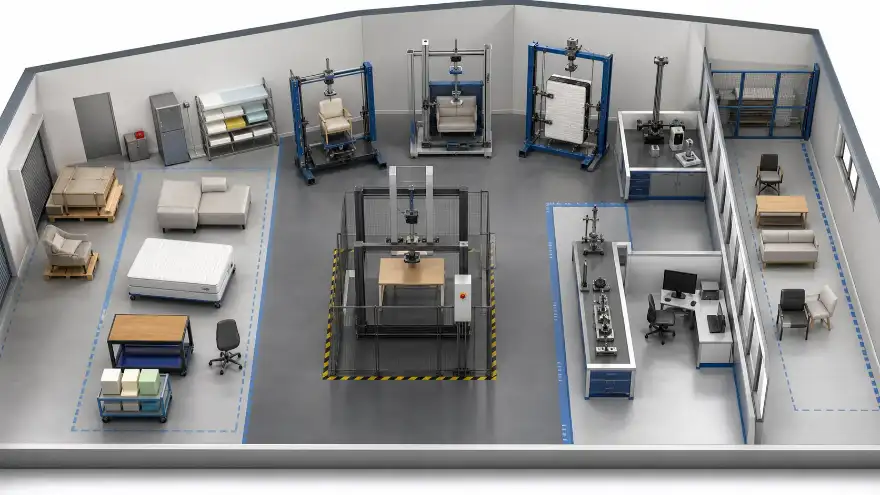
| Zone | Purpose | Planning questions |
|---|---|---|
| Receiving and quarantine | Identify, inspect and hold samples before testing | Can samples be moved without crossing active test zones? Is status clearly controlled? |
| Conditioning and storage | Keep samples under required pre-test conditions | Do the selected methods specify conditioning time or environment? Is monitoring recorded? |
| Mechanical test area | Run static, cyclic, impact and stability tests | Are floor capacity, anchoring, guarding, noise, moving envelopes and emergency access adequate? |
| Measurement and calibration area | Store reference devices and perform checks | Can reference equipment be protected from impact, dust and uncontrolled use? |
| Data and reporting area | Review methods, monitor tests and issue reports | Is the workstation outside hazards but within safe observation range? Are files backed up? |
| Post-test holding area | Retain failed or completed samples for review | Is there a defined retention period and disposition authorization? |
Utilities to confirm
- Electrical supply: voltage, frequency, phase, protective devices, grounding and isolated supplies where required.
- Compressed air: pressure, flow, air quality, dryer/filter needs, isolation valve and future simultaneous demand.
- Floor and anchoring: load capacity, flatness, vibration transfer and approved anchoring method.
- Environment: temperature and humidity control where the test method or material conditioning requires it.
- Network and data: secure result storage, backup, access control and stable time/date records.
- Safety: guards, interlocks, emergency stops, safe distances, lifting aids, signage and local regulatory requirements.
6. Establish Measurement, Calibration and Maintenance Controls
Reliable results depend on the complete measurement chain: sensor, signal conditioning, controller, software, fixtures, operator setup and environmental conditions. A calibration certificate for one load cell does not validate the entire method.
Before Use
Confirm machine status, correct fixture, zero condition, visible damage, safety functions, current method and sample identity.
Periodic Control
Define calibration, intermediate checks, preventive maintenance and software/parameter backup based on method requirements and risk.
After an Event
Assess results after overload, collision, repair, relocation, failed check or any condition that could affect measurement validity.
For each measured quantity, document the range used, required tolerance, reference standard, calibration provider, interval rationale, intermediate-check method and acceptance rule. Intervals should be determined from risk, usage, stability, manufacturer guidance, method requirements and historical results—not copied from another laboratory without justification.
7. Build a Controlled Test Workflow
- Receive and identify the sample. Assign a unique identifier and record condition, configuration and supplied information.
- Review the request. Confirm the decision required, standard, edition, test item and any deviations before work begins.
- Condition the sample. Follow the applicable method and record relevant environmental conditions.
- Prepare the equipment. Select the approved fixture and program, perform required checks and record equipment status.
- Run and monitor the test. Control access, record interruptions and stop safely when abnormal behavior occurs.
- Inspect and evaluate. Record deformation, loosening, fracture, functional change and failure cycle where applicable.
- Review and report. Check calculations, observations, method references, deviations and approval before release.
- Retain and improve. Protect raw data, retain samples as required and feed recurring failures back to design or production.
8. Prepare a Procurement-Ready User Requirement Specification
A useful request for quotation describes the testing problem. It does not only ask for “a BIFMA machine” or “an EN 1957 tester.” Send the supplier enough information to evaluate geometry, loads, control, fixtures, safety and installation.
Laboratory equipment RFQ checklist
- product families, constructions and minimum/maximum sample dimensions;
- target countries, customers and intended-use categories;
- full standard designations, editions and required test items;
- expected sample volume, test frequency and desired simultaneous stations;
- required measured quantities, report fields and data-export needs;
- available room dimensions, access doors, floor information and lifting route;
- electrical supply, compressed-air supply and environmental conditions;
- guarding, enclosure, interlock and local safety expectations;
- installation, training, acceptance testing, documentation and calibration expectations;
- future product sizes or methods the equipment should accommodate.
9. Common Laboratory-Setup Mistakes
- Buying by standard name alone: a standard can contain several tests that need different apparatus.
- Ignoring the standard edition: fixtures, parameters and reporting requirements may change.
- Underestimating sample size: the machine frame may fit one product but not future sizes or adjustment positions.
- Planning utilities after delivery: insufficient air flow, access, power or floor capacity delays commissioning.
- Confusing flexibility with compliance: a universal frame is useful only when each configured setup meets the selected method.
- Recording only pass/fail: failure mode, cycle, deformation, photographs and configuration often provide the real engineering value.
- Skipping measurement control: an automated machine still needs calibration, checks, maintenance and controlled parameters.
- Buying every machine at once: phased expansion based on actual workload usually produces a more useful laboratory.
10. Frequently Asked Questions
What equipment does a furniture testing laboratory need?
The list depends on the products and decisions the lab supports. Most labs need sample identification and dimensional tools, product-specific strength/durability/stability equipment, the correct fixtures, reference measurement devices, safe handling equipment and controlled data records. Build the list from a test-method matrix rather than a generic package.
Can one universal machine test chairs, sofas and tables?
A configurable frame may apply static or cyclic loads to several products, but each method still needs the correct geometry, fixtures, restraint, range, control and measurement capability. Dedicated machines are often more efficient for high-cycle or high-volume work.
How much space is required for a furniture testing lab?
There is no reliable universal area figure. Add the machine footprint, full moving and sample envelope, guard opening, service access, operator position, sample transport route, conditioning/storage areas and emergency clearance. Ask for equipment drawings before finalizing the room.
Does furniture testing equipment need compressed air?
Many cyclic and static load systems use pneumatic actuators, while other machines are electric, servo-electric or hydraulic. Confirm pressure, flow and air-quality requirements for every proposed machine and calculate simultaneous demand.
Does buying compliant equipment make our lab ISO/IEC 17025 accredited?
No. Accreditation assesses a laboratory’s competence and operation for a defined scope. Appropriate equipment is one part of the system, together with methods, staff competence, measurement traceability, quality controls and records.
What should we send to Derui for a laboratory proposal?
Send the product families and sizes, target standards and editions, required test items, expected throughput, room and utility information, data/reporting needs, safety requirements and the project schedule. Photos or drawings of representative samples are also useful.
11. Explore Equipment by Product Category
- Chair testing equipment
- Sofa testing equipment
- Mattress testing equipment
- Table and desk testing equipment
- Foam testing equipment
- All furniture testing equipment
Plan a Furniture Testing Laboratory Around Your Actual Test Scope
Send your product list, target standards and editions, required test items, expected throughput, room dimensions and available utilities. Derui’s engineering team can review a phased equipment and fixture configuration for your laboratory.