
 Derui chamber
Furniture testing planning guide
Furniture testing requirements depend on what the product is, where and how it will be used, the market it will enter, and the specification named by the buyer. This guide helps manufacturers and laboratory teams turn those inputs into a practical test scope and an equipment-ready request.
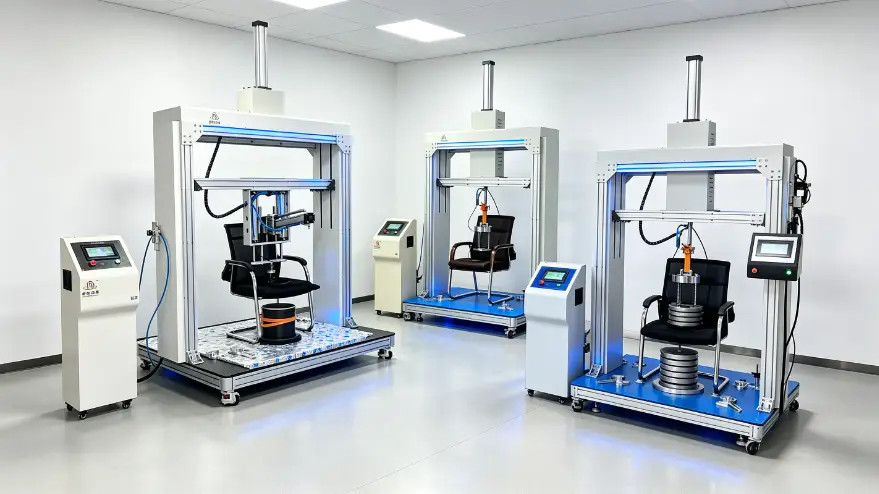
There Is No Single Test List for Every Piece of Furniture
A dining chair, a task chair, a public-lounge sofa and a mattress do not carry load in the same way. Their users, foreseeable misuse, mechanisms and failure modes also differ. A useful test plan therefore begins with classification rather than a catalogue of machines.
Standards can play different roles. One document may define test methods, another may define requirements for a particular end use, and a buyer may add its own protocol. For example, a seating test-method standard can explain how forces are applied without setting the acceptance level for every market. The signed purchase specification or approved test plan must identify the governing requirement.
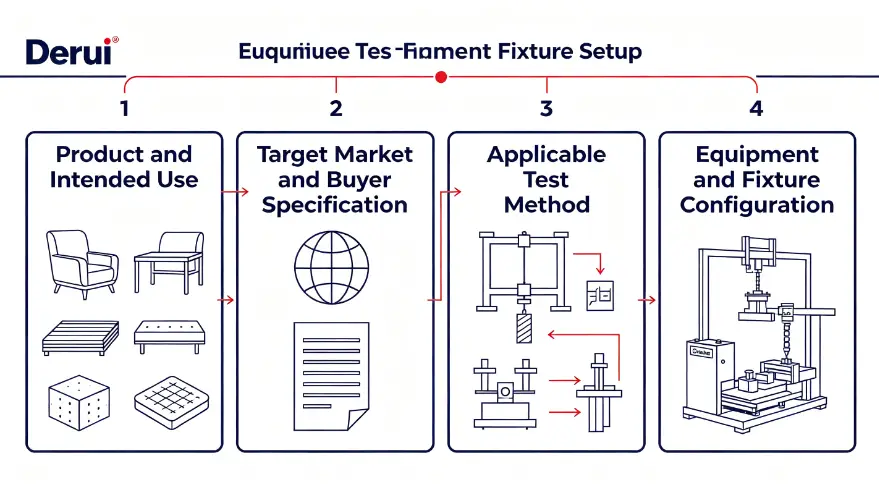
Build the Requirement from Four Inputs
- Define the product. Record the product family, model, construction, adjustable features, number of seating positions, materials, overall dimensions and maximum specimen envelope.
- Define the intended use. Domestic, office, hospitality and other non-domestic products can be evaluated at different severity levels or under different requirement standards.
- Confirm the market and contract. Identify the destination countries, customer specifications, tender documents and named standard editions. Do not select a method from the country name alone.
- Define the decision the test must support. Prototype comparison, design release, incoming inspection, routine production control and third-party reporting require different throughput, traceability and automation.
Core Furniture Test Families
| Test family | What it evaluates | Typical observations | Equipment implications |
|---|---|---|---|
| Visual and dimensional inspection | Construction, accessible hazards, dimensions, alignment and condition before and after loading | Cracks, looseness, deformation, sharp edges, loss of function and dimensional change | Measurement tools, inspection lighting, templates and controlled records |
| Stability | Resistance to overturning under defined loading and product configurations | Tipping condition, floor contact and behavior of adjustable or reclining parts | Rigid platform, stops, loading pads, force application and product-specific setup |
| Static strength | Structural response to a specified force or load applied for a defined period | Breakage, permanent deformation, joint movement and loss of serviceability | Force range, actuator direction, loading pad geometry, fixture stiffness and load verification |
| Durability and fatigue | Response to repeated loading that represents long-term use | Loosening, wear, progressive deformation, noise, component or joint failure | Cycle control, synchronized channels, stroke, loading rate, shutdown logic and cycle records |
| Impact and drop | Response to a defined dynamic event or foreseeable misuse | Cracking, sudden failure, separation, fastener damage and functional loss | Impactor geometry, drop control, release system, guarding and repeatable positioning |
| Functional performance | Operation of swivels, casters, recliners, height adjustment and other mechanisms | Travel, operation, retention, wear and change after cycling | Purpose-built fixtures, motion control, specimen interfaces and data capture |
| Materials and components | Properties of foam, upholstery, hardware or subassemblies before complete-product testing | Indentation hardness, compression set, fatigue loss, tensile/tear response or component retention | Material-specific platens, load cells, displacement measurement and specimen conditioning |
Testing Required for Chairs and Stools
Chair testing commonly covers the seat, backrest, arms, base, legs, casters, swivel or adjustment mechanisms and the product’s resistance to tipping. Office chairs, domestic chairs, stools and lounge seating must be classified separately because their intended use and applicable requirements differ.
Typical chair test scope
- Forward, rearward and applicable sideways stability
- Seat and back static strength
- Repeated seat and back durability loading
- Armrest vertical, horizontal or durability loading where applicable
- Seat or back impact
- Base, leg, caster, swivel and height-adjustment tests for applicable designs
- Inspection for structural damage, looseness and loss of function
Relevant references may include ANSI/BIFMA methods for particular office or lounge-seating categories, EN 1728 for seating strength and durability methods, EN 1022 for seating stability, or ISO 7173 for chair and stool strength and durability. The selected requirement standard and edition determine which procedures and severity levels apply.
Explore chair testing equipment, including systems for repeated seat/back loading, stability and impact. A laboratory covering multiple chair families should confirm whether one modular frame can accept all required fixtures without compromising setup geometry or throughput.
Testing Required for Sofas and Lounge Seating
A sofa is a complete seating structure with multiple load paths. Testing may need to address individual seating positions, the back, arms, frame, legs, connectors and any reclining or convertible mechanism. Cushion performance should be evaluated separately when the objective includes foam quality or comfort-layer retention.
Typical sofa test scope
- Seat and back static strength
- Repeated seat and back durability at defined loading positions
- Armrest and side-thrust loading
- Frame, leg and joint strength
- Seat or back impact where required
- Stability and mechanism function for applicable products
- Separate foam hardness, compression or fatigue evaluation when specified
Domestic and non-domestic seating requirements are not interchangeable. EN 12520 and EN 16139 are examples of end-use requirement references, while EN 1728 provides structural test methods and EN 1022 addresses stability. ANSI/BIFMA X5.4 is associated with public and lounge seating in North American programs. The customer specification must identify the applicable combination.
Review sofa testing equipment when defining station count, independent or synchronized loading, pad positions, specimen width and mechanism fixtures.
Testing Required for Tables and Desks
Table and desk testing should consider the top, supports, joints, legs, extensions, height-adjustment system and the way users apply vertical or horizontal forces. Office desks, dining tables, contract tables, outdoor tables and height-adjustable workstations can fall under different standards.
Typical table and desk test scope
- Vertical and horizontal static loading
- Horizontal or vertical durability loading
- Stability under applicable product configurations
- Tabletop deflection and residual deformation
- Impact or drop testing where required
- Extension, folding or height-adjustment mechanism function
- Inspection of fasteners, joints and structural damage
EN 1730 is commonly referenced for table test methods, while product-specific requirements can come from other documents such as EN 527-2 for office work tables or EN 15372 for non-domestic tables. ANSI/BIFMA X5.5 applies to defined desk and table product programs. Confirm the product scope before assigning a standard.
See table and desk testing equipment for configurable vertical and horizontal loading. Provide the largest tabletop dimensions, height range, loading points and whether multiple actuators must operate independently.
Testing Required for Mattresses and Bed Systems
Mattress and bed testing can evaluate complete products, mattress sets, foundations or components. The test objective should state whether the laboratory needs to measure firmness, firmness retention, durability, impact response, height change or another functional characteristic.
Typical mattress test scope
- Initial height and firmness measurements
- Repeated durability loading using the method specified for the target program
- Post-test height, firmness or condition assessment
- Impact or component evaluation when required
- Bed or foundation structural tests under a separately applicable method
- Foam or spring-component screening when the investigation requires material-level evidence
ASTM F1566 covers defined evaluation methods for innersprings, foundations, mattresses or mattress sets. EN 1957 addresses durability and hardness of mattresses and fully erected beds with mattresses within its scope. The two standards should not be treated as mechanically equivalent or converted by changing only a software program.
Use the mattress testing equipment category to compare Cornell-style durability, rollator durability and firmness/height measurement needs. The specimen range, indenter or roller geometry, measurement sequence and reporting requirements must be confirmed from the selected edition.
Testing Required for Foam and Cushioning Materials
Complete furniture durability does not identify every material-level cause of failure. Flexible foam can be tested separately to compare load-bearing behavior, compression set, dynamic fatigue and recovery. These results support material qualification and troubleshooting but do not replace complete-chair, sofa or mattress testing.
Typical foam test scope
- Indentation hardness or IFD/ILD-type measurements
- Compression force-deflection behavior
- Compression set after controlled deformation and conditioning
- Dynamic fatigue and change in thickness or hardness
- Recovery measurements after a defined rest period
- Tensile, tear or density tests when required by the material specification
ISO 2439 addresses indentation hardness methods for defined flexible cellular materials. ISO 3385 covers a dynamic fatigue method, ISO 1856 addresses compression set, and ASTM D3574 contains multiple test methods for flexible cellular materials. The relevant sub-method, specimen preparation and conditioning must be named in the RFQ.
Explore foam testing equipment and provide the foam type, specimen dimensions, target method, expected force range, platen or indenter requirement and required data outputs.
Product-to-Test Planning Matrix
| Product family | Typical decisions | Common test families | Information needed before equipment selection |
|---|---|---|---|
| Chair or stool | Structural safety, durability, stability and mechanism performance | Static, cyclic, impact, stability and functional tests | Chair type, intended use, adjustable functions, standard edition and test directions |
| Sofa or lounge seating | Frame and joint durability, multi-position performance and mechanism validation | Seat/back fatigue, static, arm/side loading, impact, stability and mechanism tests | Seat count, overall width, loading positions, mechanism type and simultaneous-station needs |
| Table or desk | Load capacity, deflection, stability and long-term joint performance | Vertical/horizontal static and fatigue, stability, impact and mechanism tests | Top dimensions, height range, largest load point, adjustment system and product category |
| Mattress or bed system | Durability, hardness or firmness retention, height change and structural condition | Rollator or localized durability, measurement, impact and foundation tests | Product type, dimensions, construction, method, measurement sequence and reporting needs |
| Foam or cushioning | Material qualification, batch comparison and failure diagnosis | Indentation, compression set, dynamic fatigue, recovery and material-property tests | Material type, specimen size, conditioning, sub-method, force range and output format |
How to Turn a Standard into an Equipment Specification
A standard number alone is not enough for a machine quotation. A useful user requirement specification translates the method into measurable equipment functions without copying or replacing the controlled standard.
- Identify the exact document. Record the publisher, number, title, edition and any amendment or customer deviation.
- List the applicable procedures. A product may require only part of a broader standard, or several documents may work together.
- Define the specimen envelope. Include minimum and maximum dimensions, mass, construction and adjustable configurations.
- Map every loading interface. Record force direction, loading point, pad or impactor geometry, restraint and required travel.
- Define measurement and control needs. Include force, displacement, cycles, rate, synchronization, stop conditions and report fields required by the approved method.
- Plan utilities and safety. Confirm power, compressed air, floor loading, access, guarding, emergency stops and specimen handling.
- Define acceptance activities. Agree on documentation, calibration evidence, factory acceptance testing, installation and operator training before purchase.
What to Include in a Furniture Testing Equipment RFQ
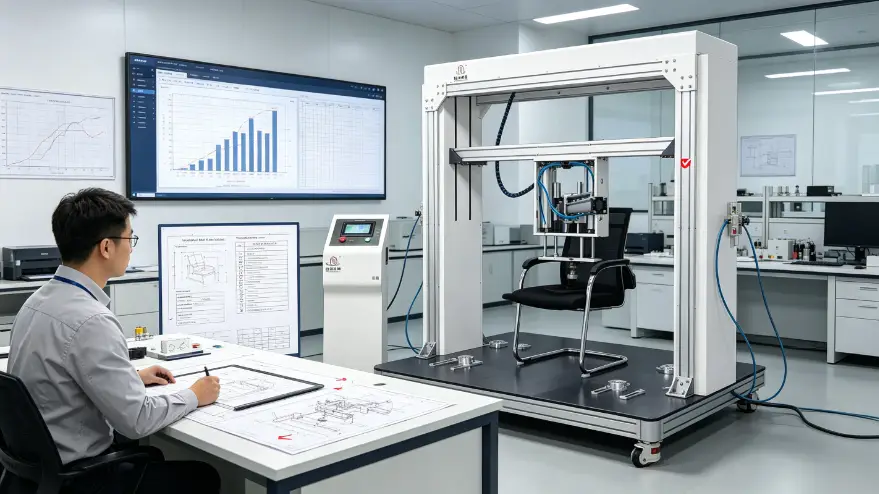
- Furniture type, model and intended use
- Target market, customer and project specification
- Standard number, exact edition and applicable test items
- Product drawings, minimum and maximum sample dimensions and mass
- Loading points, directions, fixtures and restraint requirements
- Required force, displacement and cycle ranges taken from the authorized method
- Number of stations and expected weekly test volume
- Data acquisition, report, user-access and traceability requirements
- Available electrical power, compressed air, floor space and access route
- Installation, calibration, acceptance and training expectations
For a broader facility-level process, read How to Set Up a Furniture Testing Laboratory. That guide covers test-scope development, layout, utilities, measurement control and phased purchasing.
Common Planning Mistakes
- Choosing from a standard number alone. The edition, product classification and applicable procedure can change the fixtures and control requirements.
- Confusing a test method with a requirement. A method explains how to test; a separate document or contract may define the acceptance level.
- Assuming one fixture fits every product. Geometry, restraint and load application must remain consistent with the approved method.
- Ignoring specimen size and mechanisms. Oversized sofas, reclining products and height-adjustable desks can change frame clearances and actuator travel.
- Buying automation without a reporting plan. Decide what operators, auditors and customers must see before selecting software and data channels.
- Treating component tests as complete-product approval. Foam, hardware or joint tests answer narrower questions than a complete furniture test.
Frequently Asked Questions
What are the main tests required for furniture?
Most programs draw from visual and dimensional inspection, stability, static strength, repeated durability or fatigue, impact, functional and material tests. The required combination depends on the furniture type, intended use, market and buyer specification.
Does every furniture product need the same standard?
No. Chairs, sofas, tables, desks, mattresses and foam materials have different scopes and failure modes. Domestic, office, contract and outdoor products can also follow different requirement documents.
Can one furniture tester cover several standards?
A configurable frame may support several procedures when its force range, travel, control, fixtures, loading geometry and safety functions meet each method. Compatibility must be confirmed procedure by procedure; changing software alone is not enough.
Which information should I send before requesting a quotation?
Send the product type, intended use, target market, exact standard edition, applicable test items, specimen drawings and dimensions, loading points, expected throughput, utilities and reporting requirements.
Can Derui issue a furniture compliance certificate?
Derui manufactures and configures furniture testing equipment. Certification or accredited test reports must be issued under the responsibility and scope of the appropriate testing or certification body. Confirm the required approval route with your buyer or authority.
Should a laboratory test components or complete furniture?
Use the level that matches the decision. Component tests can qualify foam, hardware or subassemblies and help diagnose failures. Complete-product tests evaluate the assembled structure and interactions between components. Many quality programs use both.
Official Scope References
- ISO 7173:2023 — Chairs and stools, strength and durability
- ISO 2439:2008 — Flexible cellular materials, indentation hardness
- ASTM F1566-14(2021) — Mattresses and foundation systems
- BIFMA standards committees and furniture product scopes
These links identify official or standards-body scope information. Purchase or access the authorized standard text before creating a test procedure. The article is planning guidance and does not replace a standard, contract or accredited conformity assessment.
Engineering support
Build a Test Scope Before You Select the Machine
Send us the furniture type, destination market, standard edition, required test items and sample dimensions. Derui will review the equipment frame, fixtures, loading channels, control functions and utilities needed for your project.
Technical response based on your test scope—not a generic equipment list.



