Derui chamber
A useful foam IFD (indentation force deflection) result depends on the selected method, specimen and loading arrangement—not on the largest number displayed in a tester brochure. Buyers comparing laboratory equipment should first define the foam being tested, the standard edition required by the customer and the measurements the laboratory must retain.
ASTM D3574 covers slab, bonded and molded flexible polyurethane foams. ISO 2439 covers indentation hardness of specified open-cell latex, urethane and PVC foams. The two documents have related concepts, but ASTM does not call ISO 2439 a complete equivalent. Select the controlled procedure before requesting a machine configuration.
1. Confirm the Test Method and Specimen
ASTM D3574
Identify the particular indentation procedure and document edition required by the buyer or laboratory. “ASTM D3574” alone is not a complete operating programme because the standard contains multiple foam tests.
ISO 2439
Specify the relevant method. ISO lists methods A–D for indentation hardness and method E for compressive deflection coefficient and hysteresis loss rate; these are not interchangeable single readings.
Production QC or formal report
For incoming inspection, decide which reading, tolerance and sampling plan the product specification uses. For a formal laboratory report, document conditioning, specimen geometry, method and results as required by the selected procedure.
2. Translate the Method into Machine Requirements
- Specimen envelope: record minimum and maximum length, width and thickness, including molded parts and finished cushion shapes.
- Contact geometry: identify the method-specific indenter and support arrangement; ask which pads or fixtures are standard and which are optional.
- Force and travel: quote the expected range for your foam grades, then confirm usable measurement performance within that range—not only sensor full-scale capacity.
- Motion and timing: ask how approach, preload, target deflection, hold and release are controlled for the chosen procedure.
- Results: specify the readings, force–deflection curve or hysteresis output actually needed, plus export format and retained test settings.
Specimen conditioning and thickness measurement can change the interpretation of IFD results. Agree who measures initial thickness, where it is measured and how the deflection percentage is derived for nonuniform samples. The controlled standard supplies the procedural details; the equipment quotation should show how the proposed hardware and software implement them.
3. Separate Foam Hardness from Other Material Tests
IFD measures a foam response under an indentation procedure. It does not, by itself, establish compression set, rebound resilience or repeated-load durability. A softer initial reading after a separate fatigue programme may be useful comparative evidence, but the before/after procedure and calculation must be defined. See the compression set versus dynamic fatigue guide for this distinction.
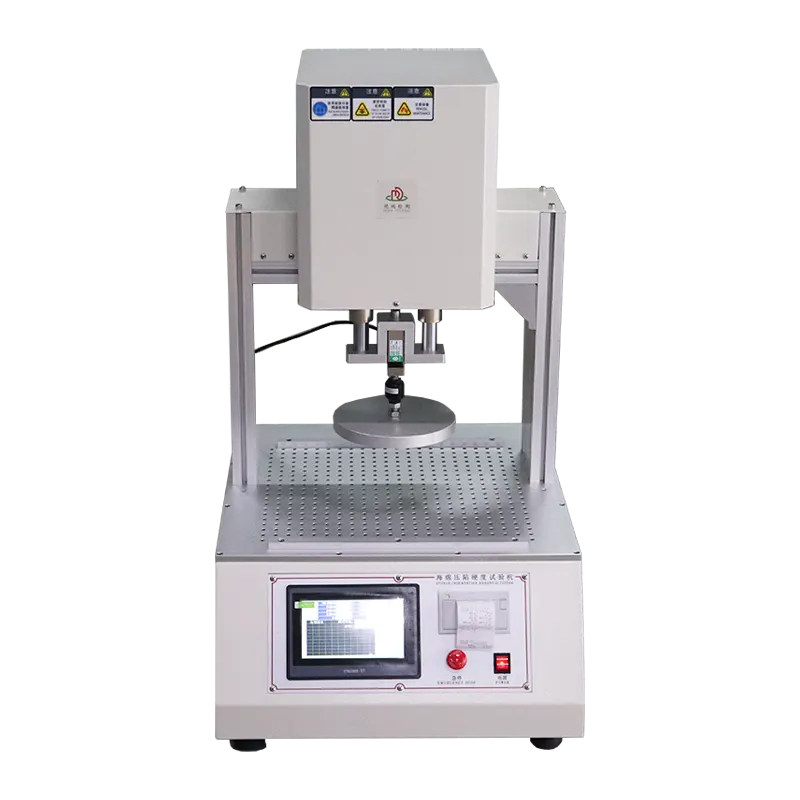
The DR-J801 foam IFD tester is the relevant product for an equipment review. If the project also needs cycling, compare the separate DR-J802 dynamic fatigue tester instead of assuming a hardness tester automatically performs fatigue.
4. Acceptance Demonstration Before Purchase
- Send a representative foam sample, its dimensions and the required method edition.
- Request a setup drawing or photographs showing the indenter and support surface.
- Ask for a sample test record with the method settings, force and deflection results and any curve or export fields required.
- Check repeatability on a defined reference or customer sample under an agreed demonstration procedure; do not accept an unsupported generic precision claim.
- Confirm calibration documentation, installation requirements, operator training and included accessories.
Frequently Asked Questions
Is IFD the same as foam density?
No. Density describes mass per volume; IFD describes force response under a defined indentation. One cannot replace the other in a foam specification.
Can one tester be used for ASTM D3574 and ISO 2439?
Possibly for selected methods when the installed fixtures, control and measurement functions match each procedure. Request a written method coverage review rather than assuming universal compliance.
Should a buyer specify data frequency or optical-encoder resolution?
Only if those values are required by the project and confirmed by the proposed machine. The current article does not assign unverified DR-J801 electronics or resolution figures.
Related Equipment and Guides
Browse foam equipment
Foam Testing Equipment for hardness, fatigue and compression-set tasks.
Understand foam tests
Compression Set vs Dynamic Fatigue to avoid buying one tester for the wrong outcome.
Plan calibration
Equipment Calibration Checklist for measurement acceptance and records.
Scope sources: ASTM D3574-25 official scope · ISO 2439:2008 official abstract. This practical guide does not reproduce a paid standard or replace the controlled edition, approved test plan or machine specification.