Derui chamber
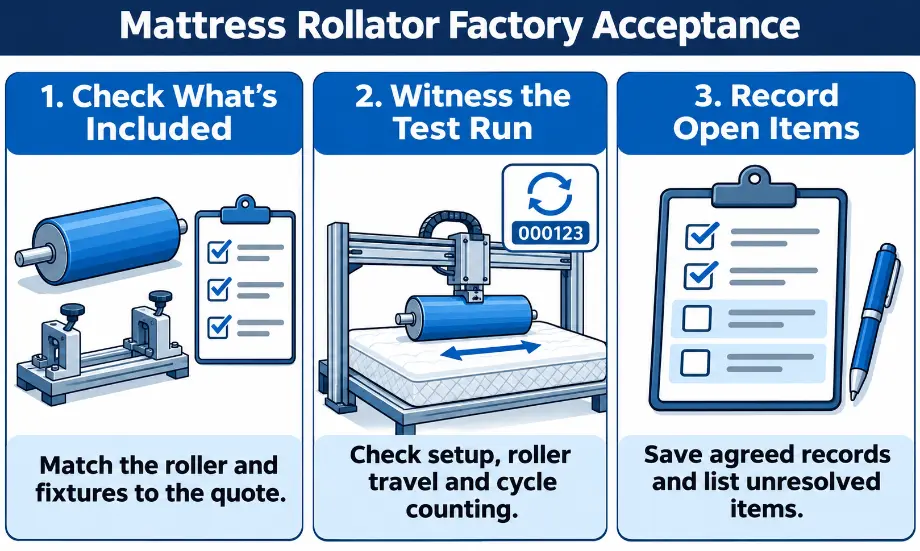
Before accepting a mattress rollator, check the supplied roller and accessories, representative mattress fit, programmed movement, retained records and any purchased height or firmness measurements. Agree the demonstration and evidence before shipment. A short running video alone does not verify the full purchase scope.
The checklist should be agreed with the supplier in advance. It is not a universal Derui service promise, a certification or a substitute for testing the mattress itself. Use it to decide what the acceptance demonstration will show, who will witness it and which open items must be resolved.
1. Freeze the Configuration Being Accepted
Attach the quotation revision, equipment identity and accessory list to the acceptance plan. Identify the actual roller assembly, supports, loading accessories and any additional measurement equipment. A claim that the machine references two standards does not establish that both required roller arrangements are supplied.
If a second assembly is optional, record that explicitly. Do not add masses, dimensions or method settings from another supplier to the purchase record. The relevant controlled method and approved equipment drawings must provide the acceptance basis.
2. Use a Representative Mattress and Define What It Proves
Agree mattress dimensions, thickness, construction and support arrangement. Check loading access, usable travel, restraint locations and the operator workflow with that specimen. A successful demonstration on a smaller sample does not establish clearance for the largest mattress in your range.
The sample can demonstrate fit and sequence execution, but it cannot prove every mattress will meet product acceptance requirements. Keep machine acceptance observations separate from mattress performance conclusions. If the demonstration sample differs from production, state the limitation.
3. Observe the Sequence and the Records Together
Before the run, record the selected programme, setup identity and counter state. During the agreed demonstration, check that the intended movement and displayed records correspond. Discuss pause, interruption and restart behaviour according to the supplier operating instructions; do not improvise hazardous fault tests.
Ask how an interrupted run is identified in the retained record. A counter visible in a video is not the same as a traceable result file. Confirm which settings, counts and observations can be retrieved after the demonstration.
| Check | Evidence to request | Record the boundary |
|---|---|---|
| Supplied roller and accessories | Assembly identification, accessory list and agreed documentation. | Included, optional or not supplied. |
| Specimen fit | Representative mattress dimensions and setup photos. | What the demonstrated sample does not cover. |
| Run and interruption records | Selected settings, counts and restart handling under the approved instructions. | What is retained versus only displayed. |
| Measurement functions | Instrument identity and sample height/firmness output if purchased. | Separate instruments or manual work still needed. |
| Handover | Documents, utility requirements and outstanding-action record. | Agreed site checks and actual service scope. |
4. Treat Height and Firmness as Explicit Measurement Tasks
If the purchase includes height or firmness measurement, identify the instrument, procedure and sample output used to demonstrate it. Check units, specimen identity, measurement locations and how before-and-after records are connected. Do not infer automatic measurement from a loading head visible on the machine.
A sample report should show the fields you actually require. If a function is excluded, record the external instrument or additional task needed. This makes a simpler configuration transparent instead of allowing a buyer to discover a missing measurement after arrival.
5. Close Acceptance Items and Plan the Site Check
Separate accepted items, accepted-with-action items and unresolved items. Give each unresolved item an owner, evidence requirement and agreed completion point. Avoid an unqualified “FAT passed” label when a supplied assembly or required record is still outstanding.
Factory checks do not remove site responsibilities. Transport condition, installation utilities, positioning and the agreed commissioning demonstration still need review after delivery. Confirm the actual installation and training service in the contract; this guide does not promise a fixed response time or onsite attendance.
Questions Buyers Ask
Must the supplier run a fixed number of hours?
Agree a relevant demonstration and contractual acceptance basis. There is no universal continuous-run duration established by this checklist.
Does a sample report prove a mattress is compliant?
No. An acceptance output can demonstrate equipment functionality; a product conclusion needs the actual applicable test programme and specimen evidence.
Can a remote demonstration be useful?
Yes, if the agreed views, equipment identities and retained records answer the acceptance questions. Confirm any limits on what can be witnessed remotely.
Related Equipment and Existing Guides
- Mattress Rollator Durability Tester
- Turnkey Furniture Testing Lab Setup Guide
- Furniture Testing Equipment Cost How To Compare Laboratory Quotations
References and Scope