Derui chamber
Bring frequent, decision-critical tests in-house first, provided your team can control the method and use the result. Prioritise incoming-material checks when batch acceptance is the bottleneck; prioritise finished-mattress evaluation when construction changes need investigation. Keep customer-required independent reporting separate.
Map each priority to a specimen, required result and existing instrument. The worksheet below separates material checks, development comparisons and finished-product evaluation, then makes any work retained by an external laboratory explicit.
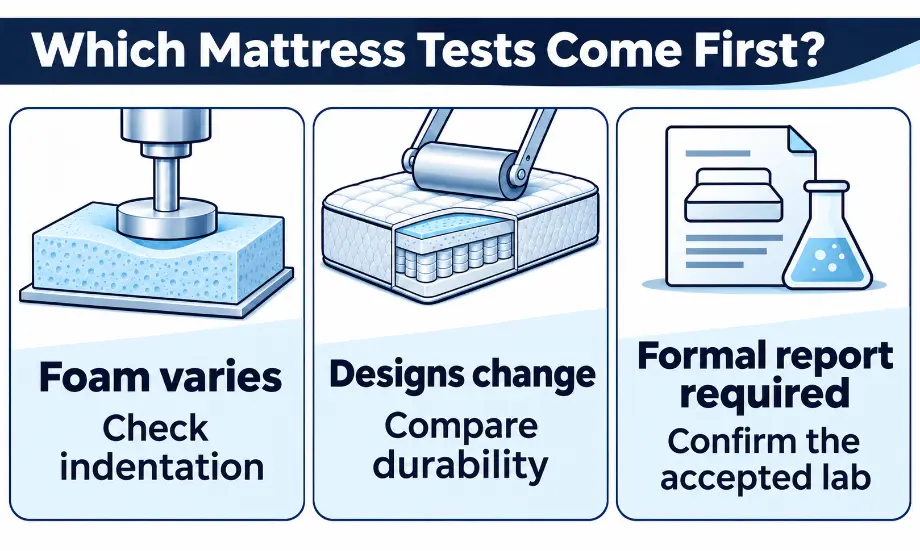
1. List the Decisions That Currently Wait for a Test
Review recent material approvals, development trials and customer requests. Record what was being decided, which result was missing, how often it was needed and whether an internal record would have been accepted. Keep actual turnaround records rather than assuming every outsourced test delays production.
An incoming foam batch may need a specified indentation reading, while a revised mattress may need an agreed finished-product durability programme. They are different specimens and different decisions. Put the required output beside each task before attaching a machine model.
2. Separate Frequent QC from Periodic Qualification
A stable incoming-material check may suit a small internal workflow if sampling, preparation, conditioning and measurement can be controlled. A rare test or a buyer requirement for an independent report may be better placed with a suitable external laboratory. Owning the apparatus does not by itself make an internal report accredited.
For development, define the comparison: the construction change, reference design, specimen identity and measurements before and after loading. A new mattress should not be described as qualified simply because one comparative trial looks favourable.
3. Buy the Measurement Chain, Not Just the Loading Machine
For indentation hardness, review the indenter, support, measuring range and retained results against the requested procedure. For compression set, exposure fixtures and an oven do not remove the need for controlled thickness measurements. For mattress durability, a rolling or pounding sequence does not automatically include every height or firmness measurement.
List instruments already available and ask which can legitimately serve the proposed workflow. Confirm compatibility rather than purchasing duplicate instruments or assuming a single controller provides all outputs.
| Stage | Decision and specimen | Equipment direction | Release evidence |
|---|---|---|---|
| Incoming foam | Accept the specified foam property on identified samples. | Review J801 for indentation or J204 for compression set as required. | Approved sampling/preparation record and the specified result. |
| Material development | Compare candidate fillings under an agreed procedure. | Review loading and before/after measurement tasks separately. | Traceable reference and candidate records; not a service-life prediction. |
| Finished mattress | Evaluate the actual mattress construction. | Review J503-1 rollator or J504 Cornell direction against the required method. | Defined mattress setup, programme and measured changes. |
| Buyer acceptance | Meet the report scope requested by the customer. | Internal work plus external laboratory where required. | Report identifying scope, specimen and responsible laboratory. |
4. Release the Next Purchase Against a Practical Milestone
A staged purchase needs a reason to progress. Suitable milestones include staff completing an agreed demonstration, a repeatable record being produced or an identified external task becoming frequent enough to justify an internal station. Choose the milestone for your operation; there is no universal monthly sample count that makes a machine economical.
Include operator time, sample preparation, utilities, verification, maintenance and external reporting in the review. Without actual costs and test demand, a precise payback period is speculation. Keep the calculation open until your own inputs are available.
5. Prepare a Small, Usable Capability Plan
Use the worksheet in this guide as a purchasing discussion, not a fixed recommendation that every factory must buy the same machines. A production manager should be able to see which decision each proposed item supports and what remains outside the scope.
For the equipment discussion, provide your mattress constructions, material checks, current instruments and required records. Derui can review the corresponding equipment directions; final fixtures, measurements, utilities and supply boundaries need to appear in the technical proposal.
Questions Buyers Ask
Should a new lab start with a rollator?
Only when finished-mattress rolling evaluation is an identified priority. A factory whose immediate problem is incoming foam consistency may need a different first capability.
Can internal QC replace every external report?
No. Agree the customer and programme requirements. Internal control data and independent acceptance evidence have different purposes.
Can one purchase cover foam and complete mattresses?
Some suppliers offer combined functions, but each specimen, fixture, measuring task and method still needs a written coverage review. Do not infer coverage from the frame size.
Related Equipment and Existing Guides
- Mattress Rollator Durability Tester
- DR-J504 Cornell Mattress Durability Tester
- DR-J801 Foam IFD Hardness Tester
- DR-J204 Foam Compression Set Tester With Laboratory Oven
- How To Set Up A Furniture Testing Laboratory
- Mattress Testing Equipment
- Sofa Cushion Foam Testing Equipment How To Plan A QC Setup
References and Scope