Derui chamber
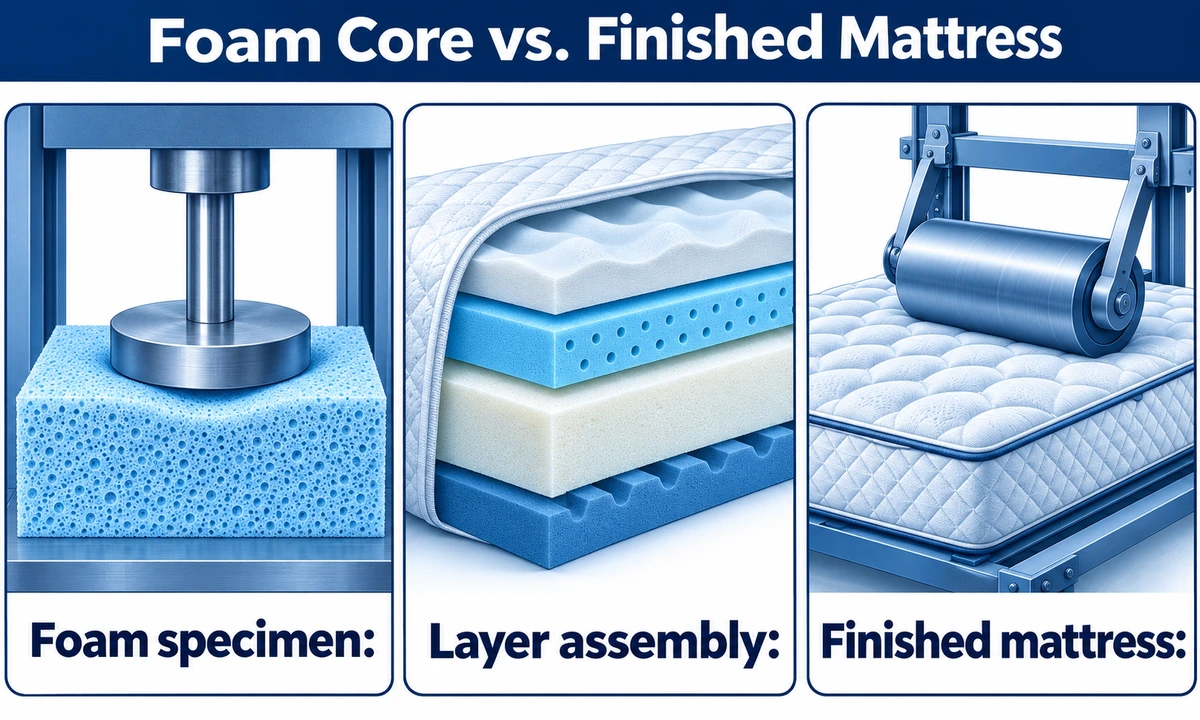
Use a defined foam specimen to evaluate the specified material property; use the complete mattress and required support to evaluate the assembled construction. A foam indentation force deflection (IFD) reading cannot directly replace a finished-mattress firmness or durability result. Select the specimen level before choosing equipment.
Choose the level of the question first: incoming material, a core or layer assembly, or the complete mattress on its required support. Then define the method and measurement. This guide is about that decision boundary, not a conversion between foam readings and mattress ratings.
1. Write the Claim Beside the Physical Specimen
If the question is whether an incoming foam grade matches an agreed specification, identify the material specimen and its preparation. If the question concerns a laminated core, describe the layers, orientation and bonding. If it concerns a finished mattress, identify the full construction and supporting arrangement.
A result should remain attached to that description. “Mattress tested” is not enough when the physical sample was only a foam block. Likewise, a full assembly result does not identify which individual layer caused an observed change.
2. Understand What Assembly Adds to the Measurement
In an assembled mattress, the cover, quilting, layer interfaces and support can affect the response recorded by a loading system. A material test does not include every one of those contributions. The same foam grade can therefore be part of assemblies that respond differently without proving the material label was wrong.
Use controlled comparisons to investigate a construction change. Record what was kept constant and what changed. Do not calculate a predicted mattress rating by simply adding individual foam IFD values; that shortcut does not establish the behaviour of the complete structure.
3. Keep Material Fatigue and Mattress Loading Separate
Repeated loading of a defined foam specimen and repeated loading of a complete mattress are not interchangeable programmes. They can use different contact arrangements, support conditions and result calculations. A machine that applies cyclic loading is not automatically suitable for both jobs.
When both levels matter, create two linked records: a material record and a finished-product record. Their connection is the batch or construction identity, not an assumption that an equal cycle count gives equivalent exposure or a fixed number of years in use.
| Decision | Specimen identity | What the result does not establish |
|---|---|---|
| Incoming foam acceptance | Defined foam sample linked to supplier and lot. | Performance of the complete mattress. |
| Layer or core development | Documented layer assembly, orientation and bonding. | An unrestricted claim covering every cover or support. |
| Finished-mattress evaluation | Complete construction and required supporting arrangement. | The isolated cause of a changed response. |
| Complaint investigation | Linked material and assembly records plus an agreed comparison. | A universal conversion between two different test results. |
4. Choose Equipment by the Required Measurement Level
Review the DR-J801 Foam IFD Hardness Tester for a defined foam indentation task and the DR-J802 Foam Dynamic Fatigue Tester for a specified foam fatigue task. For complete-mattress rolling evaluation, review the DR-J503-1 Mattress Rollator Durability Tester against the required setup. Confirm the actual fixture, measuring instruments and specimen fit in each case.
A sufficiently large frame is not a method coverage statement. Ask how the proposed configuration implements the required support, contact geometry and measurements. Where a core assembly does not fit a defined method, the responsible laboratory should agree how the result will be used and reported.
5. Use a Two-Level Investigation Instead of Replacing Everything
For a complaint about changed finished feel, begin with the traceable construction and retained material records. Check whether the relevant foam batch, layer arrangement or cover changed before deciding that the test machine needs replacement. A controlled recheck can narrow the investigation.
If a material result remains consistent while the assembly response changes, that is a reason to investigate assembly variables, not proof of a particular defect. Keep observations and suspected causes separate. Record the next comparison needed to test the explanation.
Questions Buyers Ask
Can I use a foam IFD value as the finished mattress rating?
Not as a direct substitute. The specimen, loading arrangement and reported quantity must match the claim.
Does matching foam density guarantee matching firmness?
No. Density and indentation response are different properties, and assembly adds further variables.
Should every investigation test both levels?
Select the evidence needed for the actual question. Use linked material and finished-product work when it helps distinguish the possible causes.
Related Equipment and Existing Guides
- DR-J801 Foam IFD Hardness Tester
- DR-J802 Foam Dynamic Fatigue Tester — Repeated Compression Durability Testing
- DR-J503-1 Mattress Rollator Durability Tester
- Sofa Cushion Foam Testing Equipment: How to Plan a QC Setup
- EN 1957 Mattress Testing: Durability, Hardness & Lab Setup
- How to Choose a Foam IFD Tester for ASTM D3574 and ISO 2439