Derui chamber
Plan chair-family test samples by listing the orderable configurations and reviewing representation for each test action. Arms, bases, geometry and mechanisms can change the relevant sample. Ask the responsible laboratory or programme to approve the selection and report coverage; the largest chair is not automatically representative.
The purpose is not to prescribe a fixed number of samples or identify one universal “worst chair”. The responsible laboratory or programme must agree the representation. This guide provides a way for manufacturers to prepare the configuration information needed for that decision.
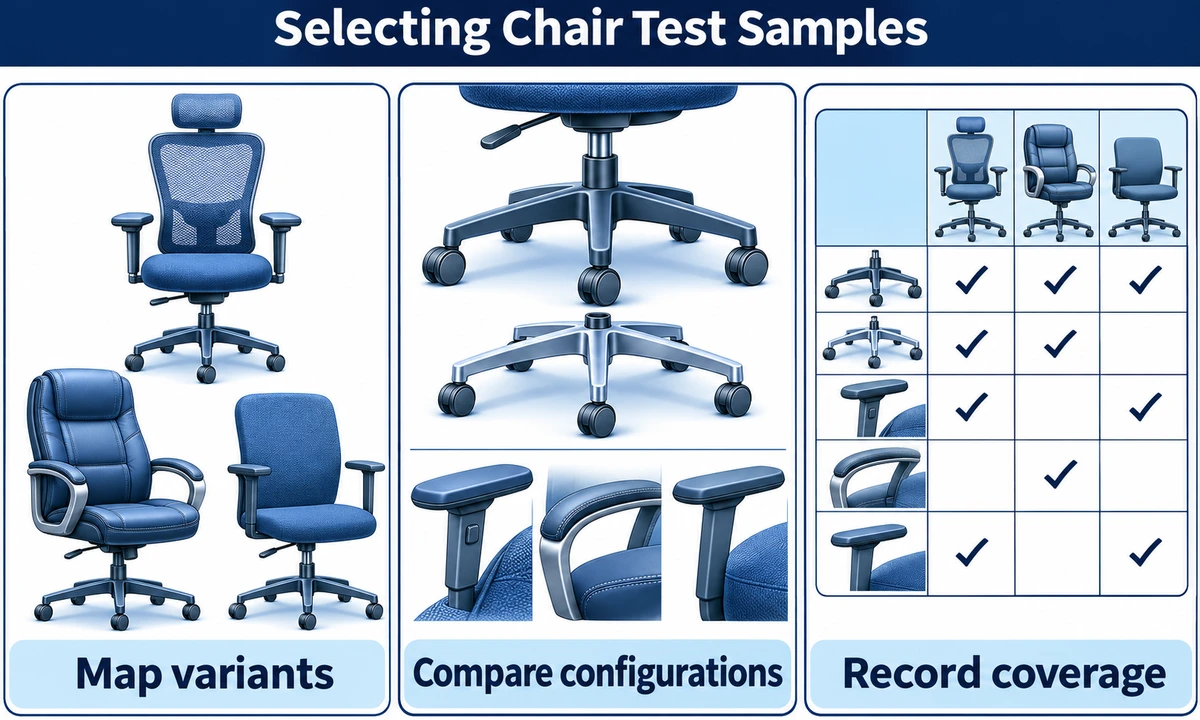
1. Build a Configuration List Before Choosing Samples
Start with the variants a customer can actually order. Record part identities, dimensions and adjustment features that may affect the planned actions. Separate a cosmetic option from a construction change, but do not dismiss a material difference merely because two parts look similar.
Useful records include controlled drawings, component references, photographs and the orderable configuration code. Keep a link to the production version. A photograph without part identification may not be enough to distinguish visually similar bases or mechanisms.
2. Review Representation One Test Action at a Time
A configuration relevant to arm loading may not be the same configuration relevant to tipping stability or seat/back durability. Geometry, supporting arrangement and adjustments can change which evidence is needed. The largest chair is not automatically the least favourable case for every action.
Ask the laboratory to document the reasoning behind its selection and any additional samples required. Do not turn this planning discussion into a blanket permission to exclude variants. A justified selection has a defined scope and can be revisited when the design or claim changes.
3. Keep Sample Allocation and Report Coverage Distinct
Choosing a physical sample for a test is one task; describing which orderable configurations the resulting evidence supports is another. Keep the test record and the proposed coverage statement alongside the configuration matrix so neither is inferred from a series name.
The applicable standard, programme and customer requirement determine the necessary evidence. An internal comparison can support engineering decisions but is not, by itself, a new independent report or approval to list untested configurations under a compliance programme.
| Variant field | Evidence to prepare | Question for the responsible laboratory |
|---|---|---|
| Arms | Fixed/adjustable construction, attachment and part references. | Which arm configurations need their own evidence? |
| Base and casters | Geometry, material, part identity and supported assembly. | Does the proposed representation cover the relevant actions? |
| Seat and back | Dimensions, attachments and adjustment positions. | Which geometry and settings should be represented? |
| Mechanism | Orderable mechanism and adjustment differences. | Are motion and restraint assumptions still valid? |
| Report scope | Tested identities and intended family claim. | Which variants remain outside the evidence? |
4. Plan Equipment Access for the Selected Configurations
Before buying internal equipment, provide the seat/back geometry, base, arms and adjustment envelopes of the proposed samples. Review whether the loading pads, restraints and working area can reproduce the required arrangements. Fixture fit on one variant does not establish fit on the whole series.
The DR-J609 Chair Seat & Back Durability Tester and the DR-J608 Chair Stability Tester address different tasks. Their relevance should be checked against the selected configurations and procedures, not a general request for a “BIFMA chair machine”. Other actions may require other apparatus.
5. Maintain the Matrix as a Controlled Record
Attach the laboratory decision, report references and unresolved cases to the matrix. When a new option is introduced, use the engineering-change process to review its effect rather than silently placing it under the old sample selection. Keep the original reasoning available.
For example, a hypothetical series could offer fixed and adjustable arms with the same seat and back. The planning question is which arm-related evidence is needed for each construction, not whether the marketing name stayed the same. This is an illustration, not a Derui customer case.
Questions Buyers Ask
Does the largest model always represent the family?
No. Representation depends on the action, construction and reasoning accepted by the responsible laboratory or programme.
Can a shared component justify one family report?
It can be relevant information, but it does not alone establish the scope of a report covering different assembled configurations.
Is this the same as reviewing a supplier change?
No. This article plans initial representation across a product range. Later changes need their own documented review of the existing evidence.
Related Equipment and Existing Guides
- DR-J609 Chair Seat & Back Durability Tester
- DR-J608 Chair Stability Tester
- ANSI/BIFMA X5.1 Office Chair Testing Guide
- Office Chair Testing Equipment for BIFMA X5.1 Labs